
SCOTUS Just Killed the Tariff Power Grab — Here’s What to Buy Now
 PriyankaLv.104 min read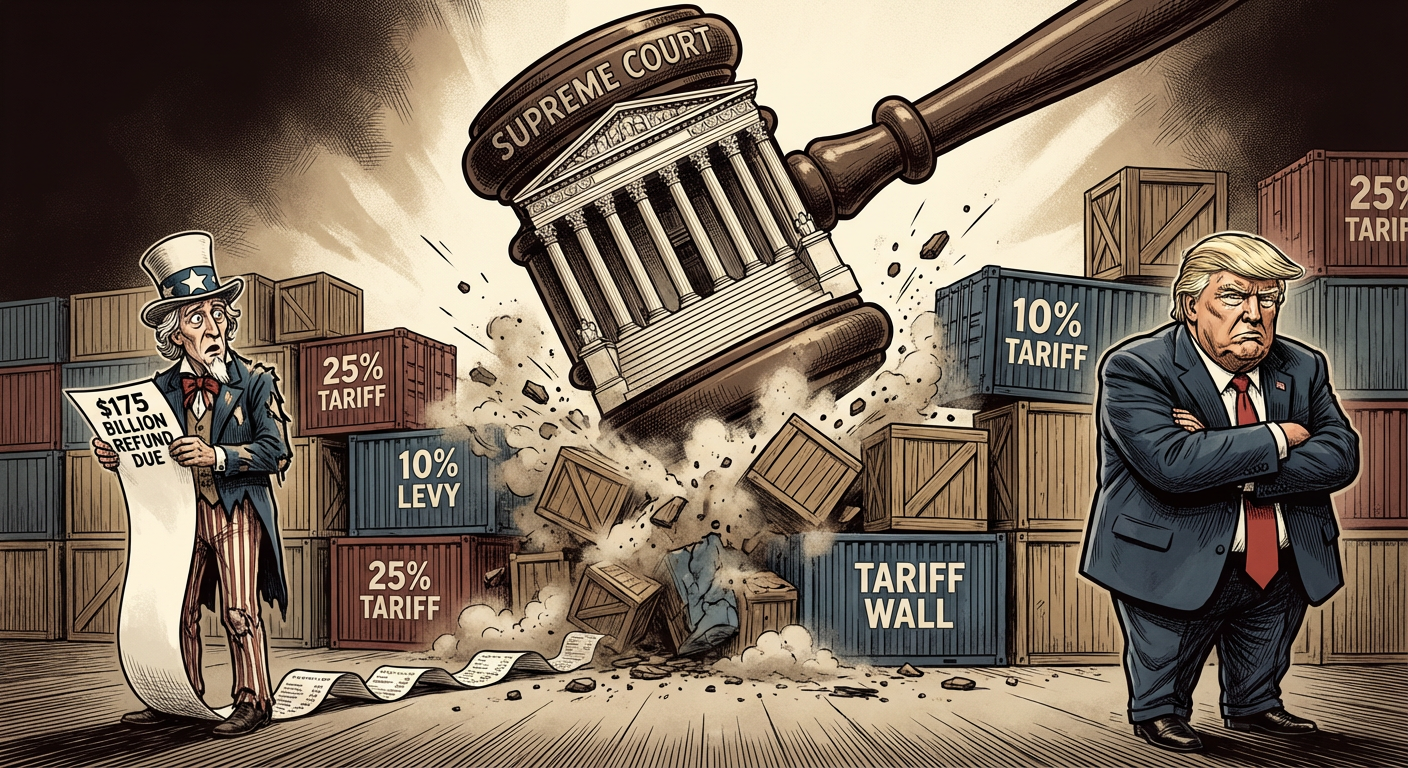
The President Can't Tax You Alone -- And That's Bullish
The Supreme Court just shut down the broadest use of emergency tariff power in modern history. That means lower input costs, wider retail margins, and a potential unwind of one of the most distortionary policies of the last year.
The Supreme Court just handed down one of the most consequential economic rulings in modern American history. Six justices, including three Trump appointees, told the President of the United States that he cannot unilaterally impose taxes on the American people.
And the market barely flinched.
The Ruling That Changes Everything
In a 6-3 decision authored by Chief Justice John Roberts, the Supreme Court struck down Trump's sweeping tariffs imposed under the International Emergency Economic Powers Act (IEEPA). The ruling invalidates tariffs that have generated over $175 billion in revenue since implementation, according to Penn Wharton Budget Model estimates.
Roberts did not mince words:
"Based on two words separated by 16 others in IEEPA, the President asserts the independent power to impose tariffs on imports from any country, of any product, at any rate, for any amount of time. Those words cannot bear such weight."
The conservative justices joining Roberts included Neil Gorsuch and Amy Coney Barrett, both Trump appointees from his first term. All three liberal justices concurred on the statutory grounds. Only Clarence Thomas, Samuel Alito, and Brett Kavanaugh dissented.
The Numbers Behind the Noise
Here is what the ruling means in cold, hard statistics:
The Tariff Damage Report:
- 17%: The average effective tariff rate before the ruling, the highest since the early 1930s per Yale Budget Lab
- $175 billion+: Tariff revenue now potentially subject to refunds
- $1.24 trillion: The 2025 U.S. goods trade deficit, a record high (tariffs were supposed to shrink this)
- 7%: The decline in U.S. imports in 2025 as supply chains restructured around the tariffs
What to Buy: The Direct Winners of the Tariff Reversal
The removal of IEEPA tariffs creates clear winners and losers. Import-dependent retailers and consumer goods companies face immediate margin expansion opportunities. Here is the playbook:
Immediate Beneficiaries:
| Sector | Why It Wins | Key Tickers |
|---|---|---|
| Big Box Retail | Lower input costs on imported goods | WMT, TGT, COST |
| Consumer Electronics | Reduced component costs from Asia | AAPL, DELL, HPQ |
| Footwear & Apparel | Vietnam/China sourcing gets cheaper | NKE, LULU, GAP |
| Home Improvement | Imported materials, tools, hardware | HD, LOW |
| Furniture & Home Goods | Asia manufacturing dominates | WSM, RH |
| Auto Parts | Complex global supply chains | AAP, AZO, ORLY |
Small furniture retailers have faced what CNBC called an "existential threat" from tariffs. With most production happening in Asia, these businesses saw costs spike while larger competitors absorbed the hit. This reversal could save hundreds of small businesses from bankruptcy.
Warning: The Uncertainty Trade
Treasury Secretary Scott Bessent has already signaled the administration will invoke other legal justifications to retain tariffs where possible. Section 232 (national security) and Section 301 (unfair trade practices) remain available. But as AP News reports, "none of these alternatives offered the flexibility and blunt-force dynamics that IEEPA provided."
The smart money is positioning for lower tariffs but not zero tariffs.
The Constitutional Question Nobody Is Asking
Lost in the market noise is a fundamental question about American governance. For the first time in history, a president used a 1977 emergency powers law to impose sweeping tariffs without Congressional approval. The Supreme Court said no.
Roberts invoked the "major questions" doctrine, writing that if Congress wants to delegate the power to make decisions of "vast economic and political significance," it must do so clearly. Trump's tariffs failed this test.
California Governor Gavin Newsom captured the moment's political stakes: "Time to pay the piper, Donald. These tariffs were nothing more than an illegal cash grab that drove up prices and hurt working families."
Senate Democratic Leader Chuck Schumer called it a "victory for the wallets of every American consumer."
The Refund Question
Here is the $175 billion elephant in the room: Will American businesses get their money back?
Kavanaugh warned in his dissent that the refund process is "likely to be a mess." The Court deliberately said nothing about whether or how refunds should happen. Importers paid these tariffs. Some passed costs to consumers. Others ate the losses. Unwinding this will take years of litigation.
For investors, this creates a secondary opportunity. Companies that absorbed tariff costs rather than passing them through may see margin expansion even without formal refunds.
What Trump Does Next
Trump's response was predictably furious. He called the ruling "terrible" and said he was "ashamed of certain members of the court" while praising Kavanaugh's dissent.
But the President also signaled this fight is not over: "Other alternatives are available to me to pursue tariffs."
Watch for:
- Section 232 invocations claiming national security threats
- Section 301 investigations into unfair trade practices
- Congressional pressure for new tariff authorization
- Executive creativity testing other statutory interpretations
The Bottom Line
The Supreme Court just told a sitting president he cannot unilaterally tax Americans. Three of his own appointees joined that rebuke. $175 billion hangs in the balance. Consumer prices should fall. Import-dependent stocks should rise.
And yet the most remarkable thing about this historic day is how unremarkable the market reaction has been.
Maybe that is because traders are already pricing in the next battle. Maybe it is because the refund timeline is too uncertain. Or maybe it is because, in 2026, we have become numb to constitutional crises that would have dominated headlines for months in any other era.
The tariff wall has cracked. What gets built in its place will shape American trade policy for a generation.
Position accordingly.
Sources: SCOTUSblog, NBC News, AP News, BBC, CNBC, Penn Wharton Budget Model, Yale Budget Lab
