
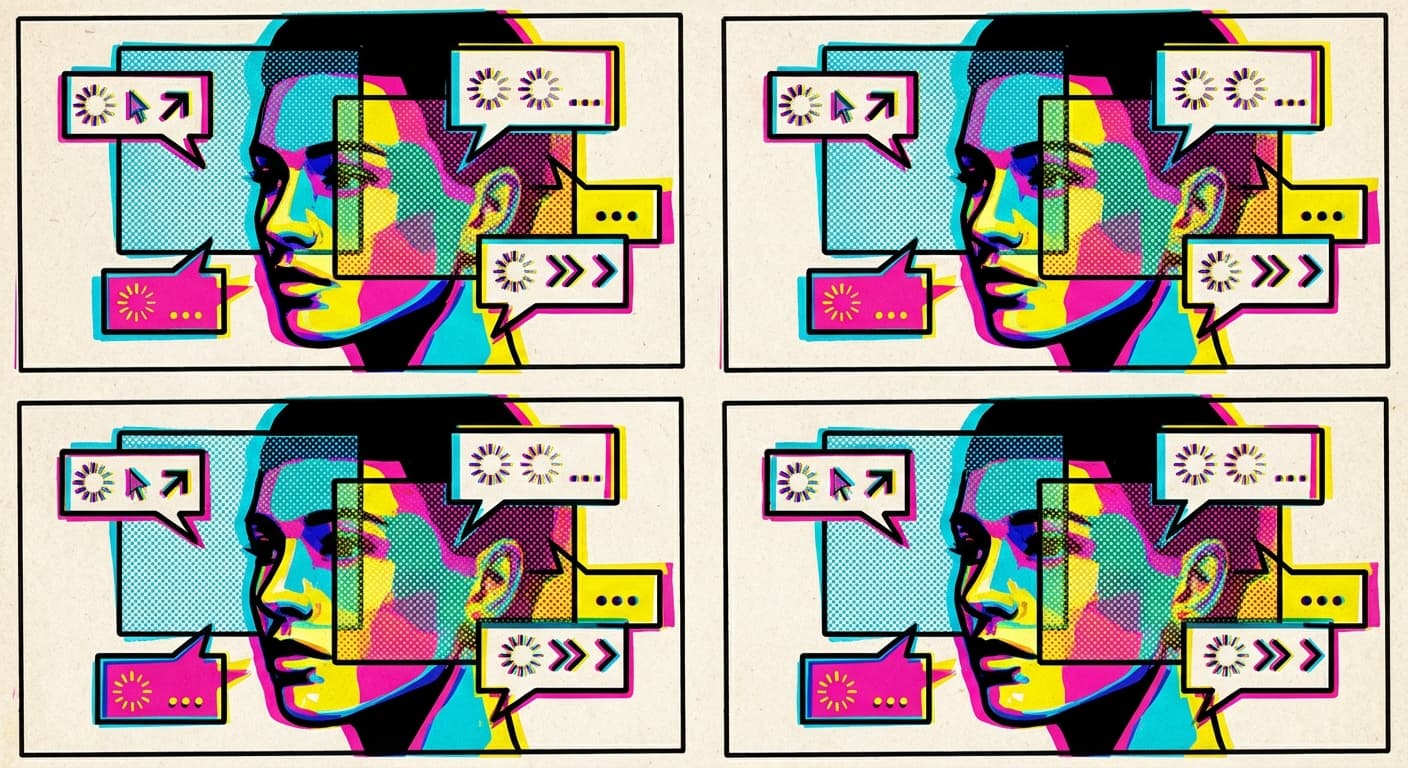
The Great Buffer: AI, Social Media, and the Coming Battle for Your Attention
 AaronLv.105 min read
For two decades, the internet ran on immediacy. Posts, comments, replies, likes--raw and unmediated--flowed directly from one human nervous system into another. Social platforms rewarded speed, emotional sharpness, and frictionless amplification. The faster you reacted, the more visible you became. The more extreme you were, the more the algorithm smiled.
We built feeds optimized for engagement, and then we moved our cognition inside them.
The next decade will reverse that arrangement. But not cleanly. Not peacefully.
AI is about to insert itself between humans and the feed--not as another voice in the chaos, but as a structural intermediary. A filter. A shield. A pressure regulator for an information environment that became too loud, too fast, and too precisely tuned to our psychological vulnerabilities.
This layer will be called many things. Digital assistant. Personal agent. Cognitive co-pilot.
Functionally, it will become the Great Buffer.
And it will be fought over.
From Direct Exposure to Mediated Reality
The defining trait of the social era was direct exposure. You saw the post as it was written. You felt the outrage as it was expressed. You reacted in real time. The feed was a firehose and your attention was the fuel.
The Great Buffer replaces that direct pipeline with mediation.
Instead of scrolling Twitter/X, you instruct your AI to monitor it. Instead of wading through viral videos, your AI extracts trends and synthesizes insight. Instead of absorbing outrage cycles in their raw emotional form, your assistant summarizes the arguments, flags manipulative framing, and strips away rhetorical excess.
The feed becomes an input stream.\
The AI becomes the interface.
At first, this looks like convenience--summaries, digests, toxicity filters. But structurally, it is something larger. Your primary experience of the internet shifts from raw exposure to curated interpretation.
You no longer consume the feed.\
You consume your AI's model of the feed.
The Economic Problem No One Wants to Admit
There is a tension at the heart of this vision.
Every actor with the power to implement an effective Buffer is economically aligned against it.
Platforms profit from engagement intensity.\
App stores profit from platform dominance.\
Ad ecosystems profit from attention duration.\
Even users routinely choose stimulation over restraint.
The article version of the Great Buffer suggests that once AI can protect us, it will. The debate makes clear that capability does not guarantee implementation.
The more realistic trajectory is this:
The pressure for buffering is inevitable.\
The form it takes will be partial, contested, and constantly compromised.
The Great Buffer will not arrive as a benevolent layer installed by platforms. It will emerge as a battlefield--between user-aligned agents, engagement-driven companies, regulators, and the psychological appetites of users themselves.
Sanitization as Strategic Leverage
Today's platforms monetize intensity. Extremity, spectacle, tribal signaling--these reliably generate time-on-site. The system does not reward nuance; it rewards reaction.
An AI intermediary disrupts that logic.
If your AI agent is the one consuming the feed, virality loses leverage. Addictive hooks weaken. Engineered outrage is compressed into neutral summary. Redundant discourse collapses into synthesis. Emotional contagion is dampened before it reaches you.
The addictive content still exists. But the line to your nervous system is cut.
This is not abstinence. It is mediation.
And mediation shifts power.
When attention is filtered by an agent aligned with your goals, platforms must compete on informational quality rather than emotional manipulation. Sensationalism without substance becomes less effective when the first reader is a machine trained to detect precisely those tactics.
Sanitization becomes a competitive advantage.
Stratified Adoption: Who Gets Buffered First
The mass-market fantasy of universal buffering is unlikely.
The more defensible path is stratified adoption.
Power users--executives, analysts, creatives, investors, knowledge workers--will adopt buffering first. For them, signal extraction is more valuable than stimulation. Time is scarce. Noise is costly.
This mirrors historical patterns:
Ad blockers were first adopted by technical users.\
Premium news was first adopted by professionals.\
Productivity tooling preceded mainstream minimalism.\
Early AI adoption began with those who saw leverage.
For these groups, buffering is not about digital wellness. It is about performance.
Mass users may follow. Or they may not.
The Buffer does not need universal adoption to reshape incentives. It only needs to capture the attention of high-status users whose time carries disproportionate economic and political weight.
Users Don't Want Agency. They Want Delegation.
One subtle but important correction: the Great Buffer is not fundamentally about empowerment.
Most people do not want to constantly exercise self-discipline. They want plausible deniability.
"I didn't block it. My assistant filtered it."\
"I didn't disengage. I was never exposed."
Delegation is psychologically easier than restraint.
The Buffer succeeds not because it strengthens willpower, but because it externalizes it. It allows users to outsource impulse control to an agent that does not crave stimulation.
That distinction makes the model far more realistic.
The Conflict Zone
The Great Buffer will not be clean. It will be negotiated.
Platforms will build "wellness features" that sanitize just enough to reduce regulatory pressure without materially reducing engagement.
AI agents integrated into operating systems will be pressured not to undermine dominant apps.
Governments will attempt to mandate transparency while lacking the tools to audit algorithmic mediation at scale.
Users will oscillate between wanting protection and wanting raw exposure. In moments of boredom or outrage, they will override their own buffers.
This is not a tidy architectural upgrade. It is a continuous tug-of-war over how much of reality reaches you unfiltered.
The Buffer becomes a zone of contestation.
The Dark Version of the Buffer
There is another risk.
The same layer that protects cognition can quietly rewrite consensus.
Summary is power.\
Framing is power.\
Omission is power.
If your AI decides what counts as signal, it also decides what fades into irrelevance. Bias need not be explicit to be consequential. Subtle weighting, tone modulation, and narrative compression can shape perception at scale.
The Great Buffer can defend against manipulation--or become the most sophisticated manipulation layer ever built.
Power does not disappear. It relocates upward in the stack.
Who controls the Buffer controls reality's first draft.
The End of Raw by Default
Raw social media will not disappear. It will remain available--noisy, chaotic, emotionally immediate.
What changes is the default.
Instead of automatic exposure, users increasingly opt into exposure. The raw feed becomes something you deliberately step into, not something that hijacks your cognition by design.
Manual doomscrolling will eventually feel archaic--like browsing the web without an ad blocker or sorting spam by hand.
"You actually read the feed yourself?"
The cultural shift will not be toward disconnection, but toward intermediation.
A Calmer Internet--or a Different One
The modern internet is engineered to exploit cognitive biases: variable reward schedules, outrage amplification, social validation loops. These systems operate at a scale that overwhelms unaided human willpower.
Humans alone cannot outthink trillion-parameter attention economies.
Humans with AI intermediaries can.
But the outcome is not guaranteed to be utopian.
The Great Buffer could:
- reduce addictive dynamics
- dampen influence operations
- restore cognitive leverage
- shift platforms toward quality
- concentrate interpretive power in a handful of AI providers
- introduce subtle epistemic distortions
- insulate users from necessary friction
- create new forms of invisible gatekeeping
The Real Claim
The original version of this thesis framed the Great Buffer as a solution.
A stronger framing is this:
The Great Buffer is unavoidable because the feed has become too powerful for direct human exposure. But it will not arrive as salvation. It will emerge as a negotiated layer--continuously tuned, gamed, and contested.
It is not a product.
It is a structural shift in how humans interface with networked information.
The question is no longer whether AI will stand between you and the feed.
The question is who designs that layer--and whose interests it ultimately serves.
