
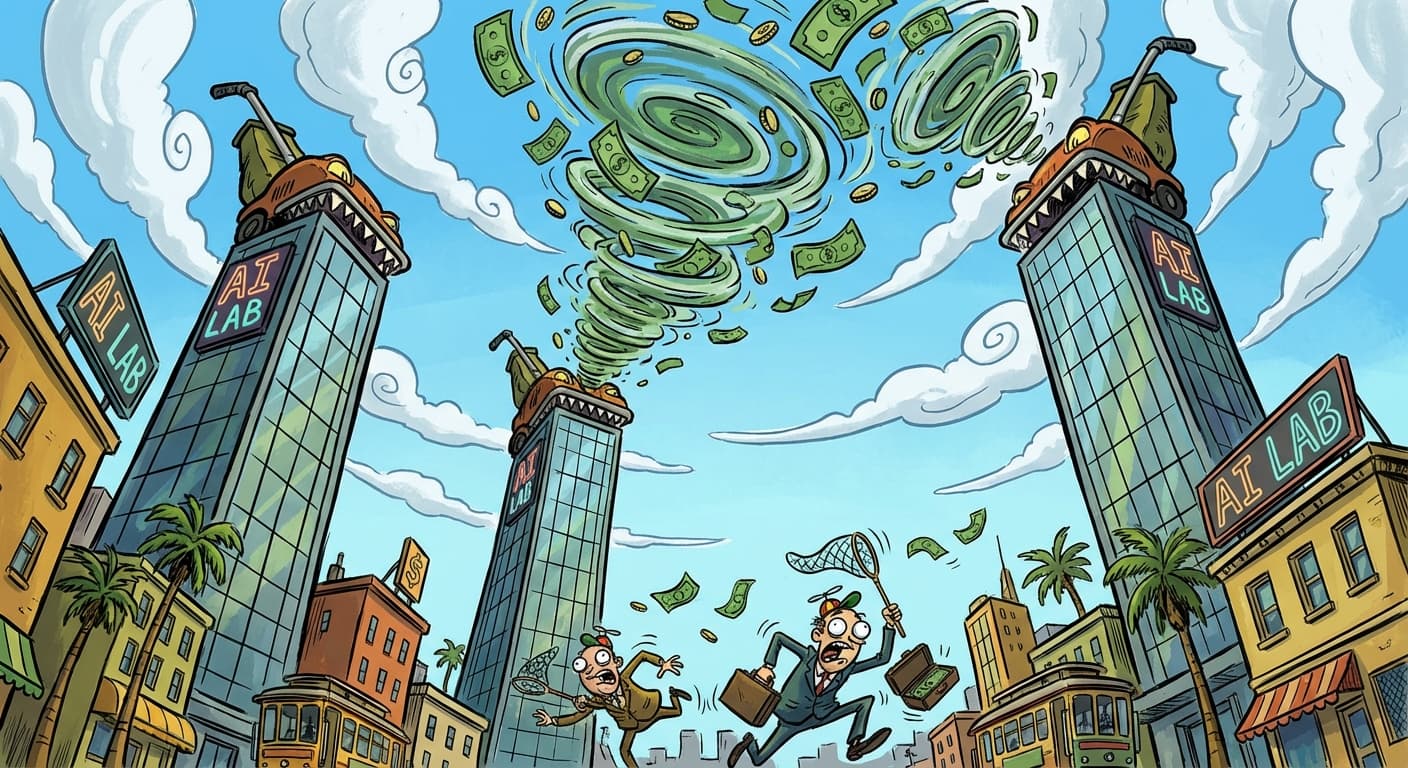
When 83 Cents of Every Venture Dollar Goes to Three Buildings in San Francisco
 PriyankaLv.108 min read
In February 2026, global venture capital hit $189 billion -- the largest startup funding month in recorded history. More money deployed in 28 days than VCs invested in all U.S. startups across the entire year of 2023.
Three companies absorbed 83% of it.
OpenAI raised $110 billion -- the largest private round ever. Anthropic raised $30 billion. Waymo raised $16 billion. Combined: $156 billion. Three rounds. Three institutions. Eighty-three cents of every venture dollar on Earth.
That is not a boom.
It is a structural fracture in how capital finds innovation.
This Wasn't a One-Month Anomaly
February was the peak of a pattern that started accelerating in January and kept building through March.
In January, Elon Musk's xAI raised $20 billion in an upsized Series E at a $230 billion valuation -- exceeding its $15 billion target. In March, OpenAI's round continued closing, with an additional $122 billion bringing the total commitment past initial estimates.
Zoom out to the full quarter and the numbers are staggering. Per Crunchbase, Q1 2026 venture funding totaled $300 billion -- a 150% increase year over year. AI captured 81% of it: approximately $240 billion.
Foundational AI startups alone -- labs like OpenAI, Anthropic, xAI, and a handful of others -- raised $178 billion across just 24 deals in Q1. That's more than double the $88.9 billion they raised in all of 2025.
Twenty-four deals. More capital than the combined GDP of most countries.
This is not a cyclical surge. It is a regime change in how venture capital operates.
The $33 Billion Market
The number that actually matters in February isn't $189 billion.
It's $33 billion.
That's what remains when you strip out the three mega-rounds. Thirty-three billion spread across thousands of startups worldwide -- roughly in line with the monthly run rate from 2024, per SeedScope's analysis. Not a record. Not a surge. Just normal.
The record was manufactured by three checks.
Meanwhile, seed-stage funding -- the earliest signal of new company formation -- fell 11% year over year. The pipeline that produces the next generation of startups is contracting while the headline number screams abundance.
The venture market isn't uniformly hot.
It's statistically hallucinating.
And the U.S. picture is even more extreme. Per Beri.net's analysis, AI startups captured 89% of all U.S. venture capital in February. Eight mega-rounds over $500 million in a single month. Late-stage deals consuming 87% of total capital.
Eighty-nine cents of every U.S. venture dollar went to artificial intelligence.
Eleven cents for everything else.
Climate. Biotech. Fintech. Defense. SaaS. Robotics. All of it, combined, splitting eleven cents.
The Circular Machine
Now look at who signed the checks.
Amazon invested $50 billion into OpenAI. OpenAI then committed to spending $100 billion on AWS over eight years. Nvidia invested $30 billion into OpenAI. OpenAI committed to consuming 5 gigawatts of Nvidia compute capacity. SoftBank added $30 billion.
The money flows in a circle.
Amazon funds OpenAI. OpenAI spends it back on Amazon's cloud. Amazon books revenue. OpenAI books a funding round. Both balance sheets swell. The market calls it growth.
Bloomberg described these as "circular financing deals in which chipmakers and cloud providers back the leading AI startups who are also their customers." A significant portion of the capital in these rounds isn't traditional equity investment. It's prepaid revenue structured as funding -- infrastructure commitments wrapped in venture mechanics.
This is brilliant engineering when demand for AI compute keeps accelerating.
It is catastrophically fragile if demand falters.
Because the losses wouldn't be contained to one entity. Amazon writes down its OpenAI stake. OpenAI can't meet compute commitments. Nvidia loses a flagship customer. The cascade propagates through every node simultaneously. Every partner is counterparty to every other partner.
This isn't diversified venture investing.
This is a leveraged bet on perpetual AI compute demand, dressed up as an equity portfolio.
Two Economies, One Name
The venture ecosystem has bifurcated into two economies that share a label but nothing else.
Economy One: The Lab Economy.
Three to five frontier AI labs operating at sovereign scale. OpenAI at $840 billion post-money. Anthropic at $380 billion. xAI at $230 billion. Valuations that dwarf most public companies on Earth. Capital requirements measured in tens of billions per round. Investors are not venture capitalists in the traditional sense -- they are infrastructure underwriters backed by corporate treasuries and sovereign wealth funds.
Economy Two: The $33 Billion Market.
Thousands of startups competing for whatever capital remains after the labs have been fed. Seed funding declining. Early-stage companies facing tighter timelines, stricter metrics, shorter runways, and a fundraising environment that bears no resemblance to the number on the front page of TechCrunch.
When a founder raising a $3 million seed round reads that February was a "record month," the headline isn't just misleading.
It's describing a different planet.
Early-stage funding -- Series A and B -- did rise 47% year over year to $13.1 billion in February. That's genuinely strong. The middle of the market is not dead.
But it is increasingly invisible. Drowned out by numbers so large they distort every aggregate metric the industry relies on.
This Isn't Just AI
The bifurcation isn't confined to artificial intelligence.
Rock Health's Q1 2026 funding report, published April 6, found the same pattern in healthcare venture: "Capital continues concentrating." Their framing: the market of haves and have-nots that defined 2025 has only deepened.
The same structural forces -- LP risk aversion, brand-name gravity, mega-round dominance, shrinking mid-market capital -- are playing out across venture broadly. AI is the most dramatic expression of a dynamic that is reshaping every sector.
This is not "AI is eating venture."
This is venture itself changing shape.
Capital, across categories, is migrating from distributed search to concentrated reinforcement.
What Concentration Costs
Capital concentration doesn't stay on cap tables. It propagates.
Talent follows gravity. When the center of capital sits at a handful of labs, the best engineers, researchers, and operators follow. Compensation inflates. Hiring asymmetry widens. Early-stage startups compete not on mission or equity upside, but against war chests funded by circular billions.
Capital concentration becomes talent concentration. Talent concentration deepens capital concentration. The feedback loop locks in.
Pricing splits in two. At the frontier, valuation logic decouples from revenue. OpenAI projects $280 billion in annual revenue by 2030 -- but currently operates at an estimated $8 billion annual loss. The market prices trajectory, not fundamentals.
Outside the frontier, the opposite happens. Scrutiny tightens. Multiples compress. Growth capital demands proof.
Two valuation regimes now coexist: inevitability-priced and fundamentals-priced. They occupy the same industry but follow entirely different laws.
Optionality contracts. Venture capital was designed as an engine of distributed search. Broad experimentation. Power-law outcomes emerging from variance. The whole model assumes that the future is unknowable, so you fund many experiments and let the market decide.
When 83% of capital flows to three companies, the system is no longer searching.
It is reinforcing.
The more capital concentrates, the more inevitable the winners appear. The more inevitable they appear, the more capital concentrates.
That loop isn't just economics. It's sociology. And it is remarkably difficult to break from inside.
The Fragility Question
There is a strong counterargument, and it deserves a fair hearing: maybe this is rational.
Frontier AI may genuinely exhibit increasing returns to scale. Compute advantages may compound irreversibly. Data moats may widen. First-mover infrastructure positions may prove durable for a decade. In that scenario, concentrating capital isn't distortion -- it's efficiency. The market is simply recognizing structural economics that prior technology cycles didn't have.
Perhaps.
But even rational concentration creates systemic fragility.
When the majority of venture capital for an entire quarter flows through a circular financing structure linking four or five corporate counterparties -- when Amazon's investment returns to Amazon as revenue, when Nvidia's investment returns as compute contracts, when every node in the network is simultaneously investor, vendor, customer, and counterparty -- the system becomes dependent on one variable:
The continued exponential growth of AI compute demand.
If that curve bends -- through commoditization, open-source disruption, regulatory friction, enterprise adoption plateaus, or simply because $840 billion valuations eventually need to meet $840 billion realities -- the repricing doesn't happen at one company.
It happens everywhere at once.
Because everything is counterparty to everything else.
And venture, which is supposed to be the most diversified form of technology investment, will have delivered the most correlated exposure in its history.
Three Possible Futures
Reinforcement. Capital continues concentrating. Labs harden into quasi-sovereign infrastructure monopolies. Venture permanently bifurcates: lab underwriting above, survival fundraising below. Small and mid-sized funds are structurally excluded from the top of the capital stack. The industry's Gini coefficient approaches one.
Repricing. AI monetization timelines stretch. The circular financing structure faces a stress test -- a single missed milestone, a single writedown, and the cascade begins. Valuations reset. Capital redistributes, violently. The $33 billion market suddenly looks like the safer bet.
Parallel markets. AI labs evolve into their own asset class -- funded by sovereign wealth, corporate treasuries, and dedicated infrastructure vehicles that don't pretend to be venture capital. Traditional venture re-normalizes around distributed experimentation for everything else. The two ecosystems stop sharing a name and start operating honestly under different labels.
Each scenario is plausible. None requires imagination. The only question is timing.
Where the Edge Migrates
If 83% of venture dollars flow to three companies, the market is not allocating across possibility. It is allocating across conviction.
But conviction in technology cycles has a poor track record.
The companies that defined the last era -- the ones that seemed inevitable in hindsight -- were rarely the ones that seemed inevitable at the time. Google was not the consensus search engine in 2000. Amazon was a money-losing bookstore in 2001. Nvidia was a gaming chip company in 2015.
Inevitability is assigned retroactively. It is almost never visible in real time.
Concentration breeds neglect. Neglect breeds mispricing. Mispricing breeds the conditions for the next wave of asymmetric returns.
For emerging managers, the math is clear: you cannot compete for allocation inside the gravity well. But you can operate where the gravity well has created a vacuum. The mid-market is thinning. Valuations outside AI are compressing. Founders building important technology in sectors the headline numbers have rendered invisible are, for the first time in a decade, underpriced.
For founders, the strategic calculus shifts. Proximity to the AI narrative accelerates fundraising velocity. Distance from it demands fundamentals, patience, and a different class of investor.
For LPs, the diversification they believe they're buying may not exist. When 81% of a quarter's deployment flows to one category, portfolio theory becomes an abstraction. Correlation risk is rising inside the asset class that was supposed to be uncorrelated.
And for the industry as a whole, February 2026 poses a question that no amount of record-setting headlines can answer:
Is this what venture capital is supposed to do?
The original function of venture was to finance search -- to distribute capital across uncertainty, tolerate failure, and let the market surface outcomes that no single investor could predict.
February's $189 billion didn't finance search.
It financed certainty.
Three companies. $156 billion. Eighty-three percent.
The question is not whether the labs matter. They do. The technology is real. The scale is unprecedented. The potential is genuine.
The question is what we stop discovering while we're busy deciding the future has already been decided.
Because somewhere in the $33 billion market -- in the 17% that didn't make the front page -- the next defining company of the next era is raising a seed round.
And the venture industry, in its current configuration, might not even notice.
Sources: Crunchbase, SeedScope, Crunchbase Q1, Crunchbase Foundational AI, Reuters, Rock Health, Beri.net
